Tuesday, May 26, 2015

Top Ten Things To Do In Shanghai

Welcome travellers to this the final China blog from my November 2013 jaunt - yes I realise it's taken a while for me to get here. If you've been with me since the beginning you'll know of the five days in Beijing, the hiking at Gubeikou, sacred mountains, armies made of terracotta, and pagodas in Xi'an. And you'll also know of the battle of the canal towns. Now with just three days left of our China adventures it was time to head to Shanghai, the city where East meets West and gets along just dandy.

Bear in mind that this was the last three days of a rather intensive two weeks and we were getting tired, so we may not have done quite as much as we would have if we had started in Shanghai, but I think this was the best way to do it. Starting in Beijing you jump in the deep end. You are immersed in the Eastern culture and there is very little familiar to you. And that is equal parts scary, alien, inspiring and incredibly humbling. Finishing with Shanghai was a good move because there is a more of a Western influence and you can pick up a coffee in a coffee shop, and more people speak English and you can find Italian restaurants and cocktail bars, and when you're feeling almost ready to return home, this is a nice sort of preparation for it.

So I'm going to give you my Top Ten things to do in Shanghai, in no particular order. We did all this in three days, but of course if you have less or longer, there are plenty of other attractions and sights to visit.


1. East Nanjing Road
 The main thoroughfare of Shanghai, runs from the Huangpu River on The Bund to People's Square, where it meets West Nanjing Road. There is a lot of bustle here with department stores, shopping malls, Madame Tussauds - if you're into that sort of thing - and restaurants. The department stores are a great place to find tasty Chinese treats to take back for presents or souvenirs. Two subway stations span the East Nanjing Road making travel easy. And there is a vast network of underpasses to get you safely underneath the very busy and very large roads. This is a great starting point to immerse yourself in Shanghai.


2. People's Square and The Shanghai Museum
People's Square is huge and dissected by a main road - again please use the underpasses, it's what they're there for. Within the sprawling green of People's Square are People's Park, The Shanghai Museum of Contemporary Art (MOCA Shanghai), the Shanghai Art Museum and The Shanghai Museum.

Now if you only have a short time to explore, I suggest a walk through the park and a trip to the Shanghai Museum. It's UFO style, futuristic architecture will leave you thinking you're out of this world. And it is free to get in and explore. The Bronze exhibit on the ground floor is well worth a look, especially if, like us, you only have time for one exhibit, but of course if you have longer then knock yourself out - not literally - and go for it. http://www.shanghaimuseum.net/en/
 Shanghai Museum

I must point out that the area around People's Square is rather seedy. There are lots of homeless people living in the park. They may approach you or try to clean your shoes - this happened to us - but you are more likely to be accosted by some young, English speaking locals who will try and persuade you to go to a tea ceremony. Don't do it! They will start by asking you to take a picture of them. There are likely to be three or more of them, and then they will tell you to follow them to a tea ceremony or a gallery, and expect you to pay extortionate prices for stuff. Again, a polite 'no thank you' might not be enough, so you may have to be persistent, but we found walking away and continuing to ignore them worked a treat.

3. The Bund/Riverside Walk
The impressive Bund is Shanghai's riverside masterpiece. Following the natural curve of the river, this is the place to catch your first glimpses of Pudong - the futuristic high rise centre on the opposite side of the river - as well as taking in the opulent dining and shopping the Bund has to offer. Consisting of many buildings you might think more at home in London, including a bell modelled on Big Ben, they hark back to the 1920s and 1930s when many affluent foreign residents had taken up here. Customs houses and bank buildings and the Fairmont Hotel; this is luxury from the Art Deco period and it's impressive.

Stroll along on the promenade and you're treated to views on both sides: The Bund and Pudong. Please make sure you do The Bund in the daytime and at night time. It's a different land when all lit up and deserves to be seen in all its guises.

Also, poke your head in The Fairmont Peace Hotel at the end of East Nanjing Road where it hits the Bund. It is a beautiful example of Art Deco. You can enter the downstairs and there are shops and cafes and often an exhibit or two that are open to the public. So you can feel five star even if you can't afford to stay there.

 Looking over to Pudong.

Quite a few of the Bund buildings have shops on the lower floors which allow you to enter and at least experience the feel of the era they were built in. Some also have restaurants and bars. Check them out. 

4. A Night on the Town: Pudong
You can't miss an opportunity to skip over the river - or under, in this case - and visit the modern metropolis of futuristic, often sci-fi looking buildings in Pudong. And when they're giving their own light show, it really would be rude not to head over there for dinner and a cocktail or two. Because if there's one thing Shanghai know all about, it's cocktails!


Head for the Jin Mao Tower to the 57th Floor and you get a choice of four restaurants. We chose the Italian, after 13 days of Chinese food, we felt ready for a pizza. The prices are relatively expensive if you compare them to other places in China, but you are on the 57th floor, with a real Italian chef with views over Pudong, and it's totally worth it. Prepare to splash out and enjoy yourself in the process. http://www.shanghai.grand.hyatt.com/en/hotel/dining/Cucina.html
 Jin Mao Building - Grand Hyatt Shanghai

Then within the same building you can shoot up a few floors to Cloud 9 bar for cocktails. They will seat you and they have a great selection of drinks with English translations. Again, you will expect to pay around £10 for a cocktail, which may seem steep if you've been travelling around in China, but as someone who lives in London and enjoys a good cocktail, they were more than worth it. They had some really interesting ingredients too. http://www.shanghai.grand.hyatt.com/en/hotel/dining/Cloud9.html

Then if you're still up for more and you don't mind heights, hop over the road to The World Financial Centre and 100th Avenue Cocktail Bar on Floor 91. It's a bit tricky to find the entrance, so watch out for the signs and if in doubt, ask. Again drinks are around £9 to £10. This bar was much busier and had less seating, so we were seated at the bar. You may have to wait for a seat, especially if you want a table with a window view.
World Financial Centre

5.Old Town
Old Town is a veritable maze of hutongs and traditional dwellings, along with streets of small shops and temples. The Yuyuan Gardens and the more modern bazaar pull big crowds with huge queues for some of the local crab entrail delicacies, and of course the dumplings. If you want a taste of traditional China in Shanghai, this is the place to get it. You can almost forget the dominating high rises and modernity of Pudong and East Nanjing Road. Here in the shaded back streets you'll find a slice of old Shanghai.

Leaving the subway at Yuyuan Gardens stop, you'll find the surrounding streets filled with covered markets and 10RMB and 5RMB shops (£1 and 50p shops). Amongst the tacky obvious throwaway novelties, there are in fact some nice souvenirs, so I would definitely check them out, especially if you have a penchant for joke presents.

The Chenxiangge Nunnery is on the way to Yuyuan Gardens and is well worth a look. It is a welcome retreat from the crowds heading to the Bazaar, and offers a moment of thought and contemplation amidst the clamour of the streets surrounding it. There is a small charge to enter, and a further charge to climb up to the first floor, but we're talking 20p, so you won't put yourself out.

 Chenxiangge Nunnery
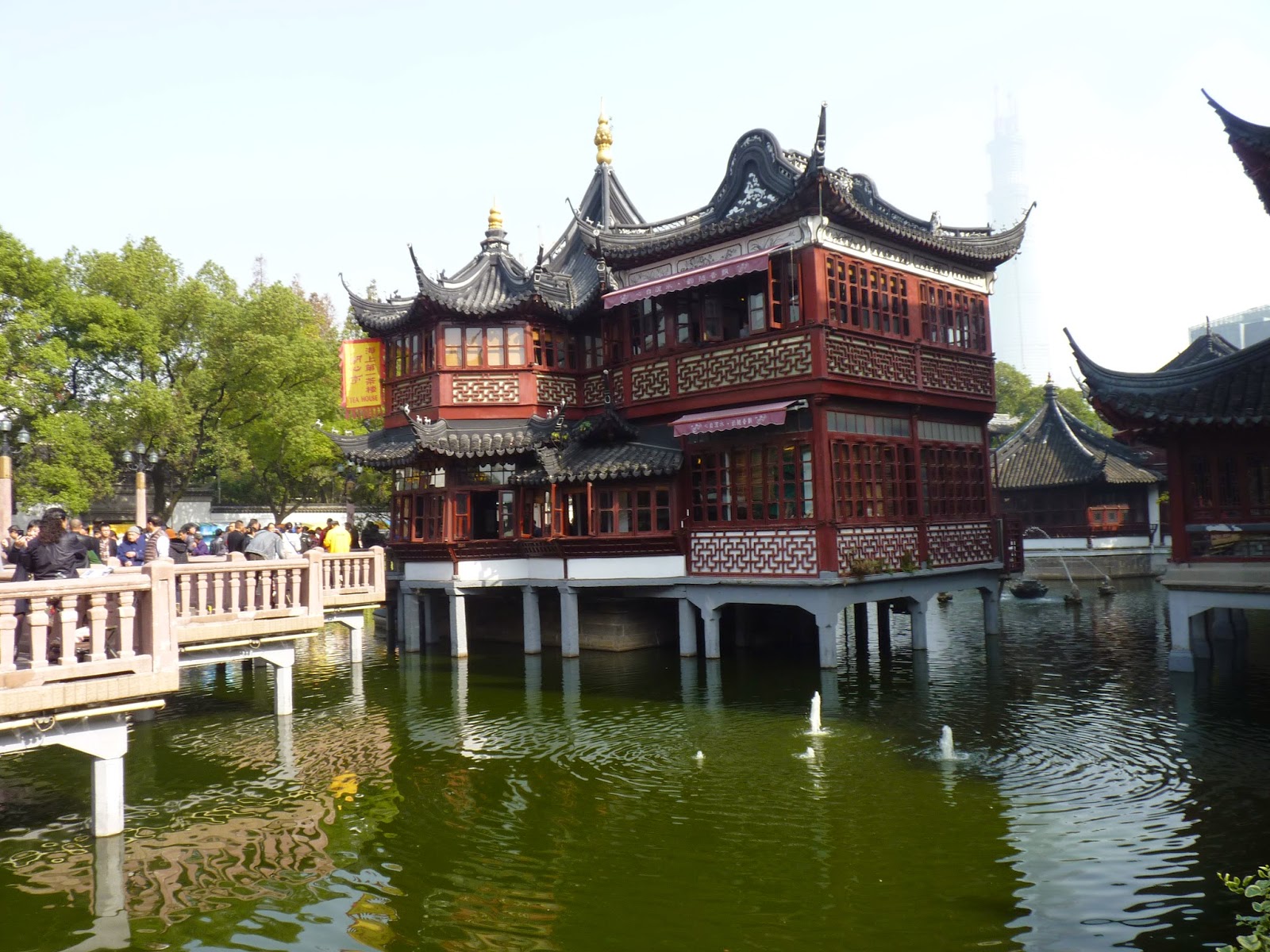
In order to reach the Yuyuan Gardens, you'll have to funnel through the shaded streets of the bazaar, so prepare to get friendly with some strangers. You'll see the iconic Mid-lake Pavilion Teahouse before you spy the entry to the garden. It has a zig zag walkway and offers some beautiful photograph opportunities. You can of course join the insane queues to have tea in the tea-house, but I would suggest that simply photographing it would save you time and money to spend elsewhere.
 Mid-lake Pavilion Tea House

Yuyuan Gardens is a super popular place to visit, and if you try and go around lunchtime or on weekends, it is likely to be swamped with groups of tourists snapping photos and getting in your way. Try and go early if you can, morning is definitely the best option.

This is a beautiful green getaway in the heart of the city. There are lots of small gardens to look around, that feed into the garden as a whole. There are lots of rocks and alcoves and small halls to explore, as well as many indigenous plants and trees.

6. M50 Art District
A little out of the centre, in the North of Shanghai, this collection of industrial buildings and warehouses, now hosts the M50 Art District. With a host of contemporary artists on display - mostly from China - you have your pick of styles and media to choose from. There are of course changing exhibitions and sculptures on display, as well as lots of interesting shops to pick up a print or arty present. There are design workshops and a couple of quirky cafes offering a variety of drinks and snacks. Depending on where you are coming from, it might be easier to get a taxi out there, as the nearest subway station is a good 15 minutes walk away, but if you are already around and exploring the area - Jing'an - which also boasts the Jade Buddha Temple and the Shanghai Centre Theatre, then you can easily walk and there are a ring of subway stations and bus stops around it.


7.The Bund by Night
Yes I have already urged you to spend a night amongst the giants in Pudong and to eat and drink up in the air, but if you have more than one night there, then you need to see the Bund by night too. Now again this gives you amazing views over Pudong and its veritable light show - which incidentally finishes around 10pm every night - as well as allowing you to see the Bund and all its remarkable buildings lit up and dazzling. A walk along the promenade is a great way to take it all in, but if you are cocktail mad such as myself, then the best way to see it all is by visiting New Heights - or one of the many other Bund watering holes - on the 7th floor of Number 3 The Bund. Wow. You may not be 91 floors up like you can be in Pudong, but the view is breathtaking, as well as their cocktail selection.


8. Tianzifang and The French Concession
My favourite part of The French Concession area had to be the incredible shopping experience of Tianzifang. If you like to shop - especially on your last day of holiday so you know exactly how much you can cram in your case - then this is the place. Consisting of a network of alleyways and longtangs, this is a labyrinth of retail and culinary fun. Think home made, think quirky, think original and think variety. This place really does have it all, as well as restaurants, cafes and bars boasting fare from all over the world. There are fresh juice stations the likes of which you'd never believe. I don't think I'd ever had freshly pressed apple juice done before my very eyes. Yum!


With all this colour and imagination you can't fail to enjoy this rather unique shopping experience. And if you're up for a novelty lunch, then look no further than the toilet themed restaurant: More Than Toilet. Sit on a throne - the less royal kind - and eat starters from a bath tub. Drink from a urinal and be pleasantly surprised by the quality of the food and drink on offer. The menu boasts some real oddities too, such as these hollowed out loaves of bread, with all sorts of sweet stuff inside. I still don't fully understand what I saw. Definitely worth a visit, and you can purchase some toilet themed souvenirs too.
A short walk away is the former house of Dr Sun Yat-Sen - we visited his mausoleum when we were in Nanjing - and the entrance to Fuxing Park. Expect communal dancing, a bit of Tai chi, people playing chess and a lovely community feel. There is also a beautiful rose garden and some nice routes to walk through.
Fuxing Park

Another shopping place in the French Concession is Xintiandi, but we found this much less interesting and much more pricey. There is a big modern mall there though were you can use the toilets and escape the cold, if needed. But I would definitely recommend Tianzifang!
 Xintiandi

9. Pudong by day
Okay, so you've seen Pudong in the day and night from The Bund. You've visited during the night for a meal and a cocktail up one of its many towers, but what about having an explore during the day? See those giants up close in daylight and maybe take a trip up to an observation deck or take a cruise along the river to see Shanghai by boat.


The Aquarium at Shanghai is a good stopping point if you have the money and the time. It boasts the longest underwater tunnel at around 150 metres, which has its own travelator that you can hop on and hop off. We went towards the end of the day with only a couple of hours to explore and found we had just enough time to see everything. By the time we emerged Pudong was lit up once again. http://www.sh-aquarium.com/en/html/index.aspx

10. A Couple of Other Notables
Finally, to finish off the top ten of Shanghai there are a couple of notable things we did or saw that are definitely worth mentioning:
  • The Rockbund Art Museum off East Beijing Road is a private collection of Asian contemporary artists. Pay a small fee to enter and you'll see a mixture of media and installations encompassing a whole range of new and well known Asian artists. They are also very nice people as my partner left his iPhone in there and only realised a few minutes after we'd left. When we went back they had kept it to one side for him. Thank you. http://www.rockbundartmuseum.org/en/

  • A culinary experience like no other I've ever had. If you like futuristic dining experiences, then one where you order everything from a touch screen at your booth will be right up your street. It's almost like a fondue, you have to order three different dipping stocks and then loads of stuff to dip in and cook yourself. It's quite bizarre especially as we didn't really fully understand what was happening and the restaurant itself was very new at the time. It was in the Hongyi Plaza Mall on East Nanjing Road, but I can't give you an English name and I can't seem to find it online. Hopefully it's still there. 
 My partner completely overwhelmed.


 And so there we have it. Shanghai is a wonderful example of East meets West, traditional meets modern, and old meets new. It has this desire to be big and bold and new and innovative, whilst still retaining some of the traditional charm. With its 'melting pot' status due to the port and the amount of nationalities that pass through here, you can understand the many influences it has experienced. And whilst there may not be as many sights and attractions as Beijing or Xian, it's more about walking around and seeing it all and soaking it all in and experiencing the life here.

You are likely to spend more money here, but not in a bad way. This is definitely a place to come and splash out and treat yourself. It's different to any other places we visited in China and believe me, that's a good thing. Everywhere you step in China is different than the last place and offers something unique and special to its visitors. Shanghai is no exception to this. And whilst some people may see it as a watered down version of the East, or a place being slowly eaten away by its Western influences, I'd have to disagree. It is a mixture of both and it is precisely this mixture that casts a spell over its visitors.

Thank you Shanghai. Maybe one day we'll be back.

And thank you readers for sticking with me through this extremely long back log of annals from our trip. I let a lot of other things get in the way, but can't wait to get started on last year's trip to The American Mid West. Oh yes. The Sarky Traveller will be back, and hopefully on a more reliable schedule.

Conclusions are: Visit China, it's ace! And also if you are on a budget this is a great chance to get far away from home without bankrupting yourself. Oh and you will eat some amazing food and see some incredible sights!

Until next time.

The Sarky Traveller


Tuesday, January 6, 2015

Nanjing Vs Suzhou: The Battle Of The Canal Towns

Who knew China had a famous network of canal towns? I definitely didn't until we started delving into the guide book and watching China nature programmes. If you are around Beijing, Xi'an or Shanghai, then there are two canal towns in the Jiangsu Province well worth a look: Nanjing and Suzhou. But if you're short of time and only have time to visit one canal town, which one should it be? Nanjing? Around four hours on the train from Beijing or a two hour flight from Xi'an. Or Suzhou? Between twenty five minutes and ninety minutes on the train from Shanghai. Hmmmm decisions.........

But don't panic, The Sarky Traveller will hit you with the best of both towns and hopefully this will help you decide. Of course if you have time for both, do them both. We did. 

Nanjing (Jiangsu Province). 
We arrived by plane from Xi'an and stayed at The Orange Hotel, which is right by the canal and not far from the main canalside sights of Dashiba Street.  http://www.orangehotel.com.cn/nanjing/Fuzimiao.html

Canalside in Nanjing

Top five things to do in Nanjing, in no particular order, other than this is the order we did them in on the day. 

1. Zhongshan Mountain Scenic Area.  http://en.zschina.org.cn/webpage/jqjj.jsp?detailId=10921&functionId=10885                                                                                              
To the East of Nanjing on the outskirts of the city, lies the Zhongshan Mountain, often referred to as 'the purple mountain.' This extensive National Park has many sights and attractions to keep you busy. As it is out of the centre you will likely need a taxi - quite difficult to flag down in Nanjing, trust me - as a taxi can take you right up to the drop off point of whichever sight you are visiting.


You should visit Dr Sun Yat-sen's Mausoleum. This man was, for a lot of people in China, a political hero and founder of modern China. But be prepared for crowds. We arrived about thirty minutes after opening and it was already filled with school groups and tour groups that had come to pay their respects. The mausoleum is a heavily trafficked tourist site with lots of stairs. Please be patient and courteous to others. Find out more here: http://zschina.nanjing.gov.cn/english_54819/


 Lots of steps. 
Looking down and out over the mountain, with Nanjing centre on the right in the distance. 

The Mausoleum site is free to enter and explore, but the other sites on the mountain carry a small entry fee. There are options of a through ticket - for all attractions - or some combination tickets, if you have the whole day to explore. 

We then took one of the shuttle buses to the Ming Tomb, as we had time for one more excursion on the mountain. 

50 pence (5 RMB) is all it takes for a little jaunt on one of these buggies. 

The Xioling Tomb of the Ming Dynasty is well worth a visit if you have a spare ninety minutes or so. Bring your walking legs and enjoy not only the tomb, gates and halls, but also the gardens and sculptures. For more information about the Ming Tomb visit the official site: http://www.njzsl.org.cn/mxl.aspx


Once you reach the main hall, there is an exhibition and gift shop, and you can look out over the tomb with a fantastic view. 

 Wow.
 The view from the top. 
                                      
The exhibition and gift shop. We picked up an English guide to the tomb. 

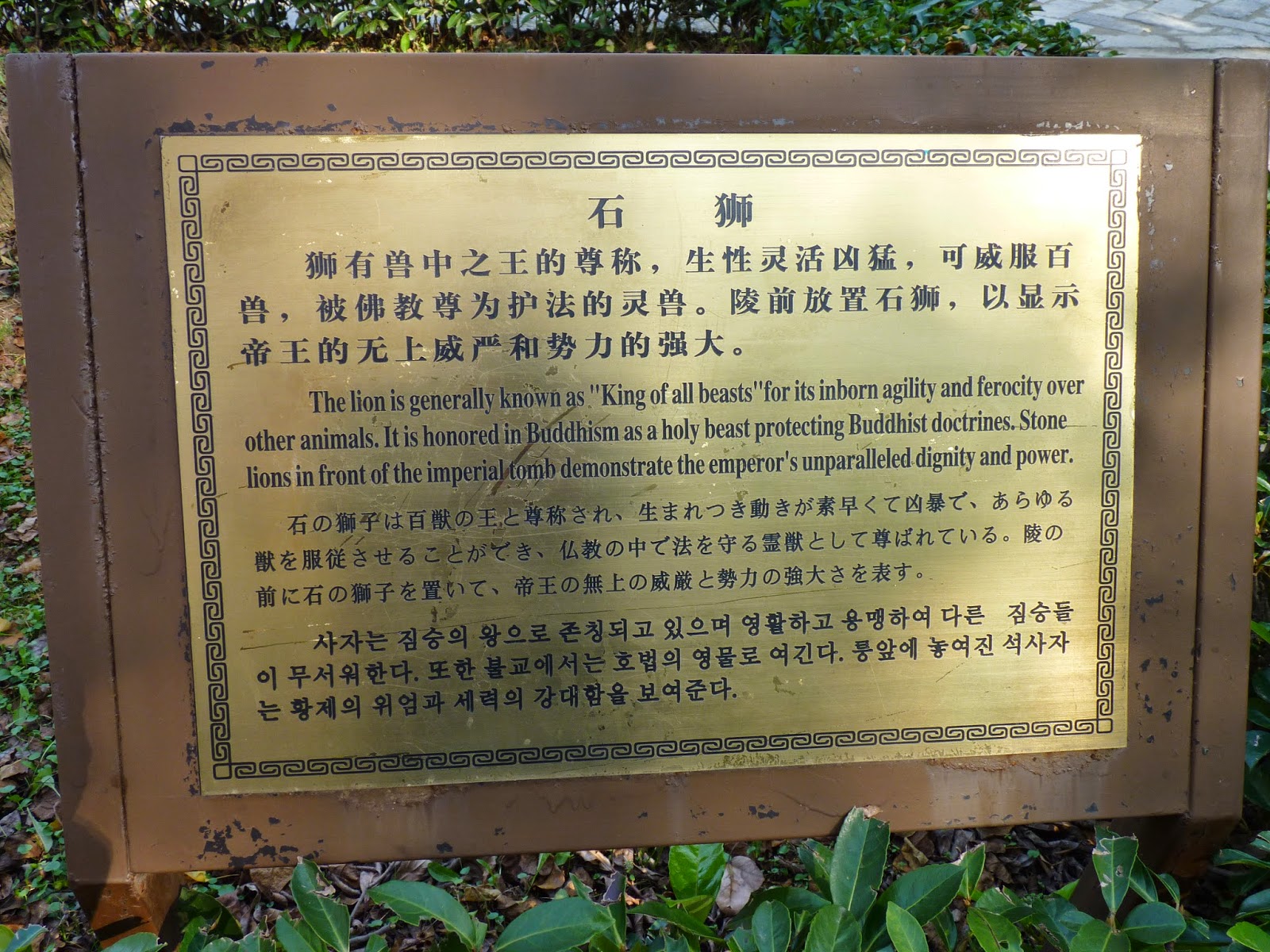
Please visit the gardens, they are so fun and have lots of statues, though the animals are probably the most beloved.  


As you head out, there are various exits along the way, so you can lengthen or shorten your walk as necessary. You may have to wait a little time to hail a taxi back off the mountain, but they will come. This is a big tourist destination for Nanjing, so just be patient and be sure to have the Chinese characters of your next destination, on hand. 

2. The Nanjing Massacre Memorial Hall http://www.nj1937.org/en/index.htm
This beautifully poignant memorial to the lives lost in the Nanjing Massacre, and to those 300,000 bodies discovered in a mass grave only 30 years ago, incorporates water, space, jutting angles and interesting sculptures, to convey the devastation brought on the city. 


 Space for contemplation. 
 The names of all 300,000 victims in Chinese characters. 
 The continuous flame
An impressive sight. 

There is no fee for entering the site but they do ask you to sign in and state your nationality. Take a while to walk around and admire the remarkable tribute to those who lost their lives. 

Now, before I continue, I must tell you where we stopped for lunch. Oh my word. Just by the Zhonghua Gate we found a tiny little eatery with tables inside and pictures on the wall. We wandered in and pointed to something we recognised. The amazing thing was that the chef then went into the kitchen and completely made it from scratch. We watched him do it. The dish was noddles, beef, potatoes and vegetables, and it was magnificent. It even came with a free bowl of broth soup. And all for the meagre cost of 12 RMB (£1.20 each). Cheapest meal ever. Oh and they over charged us at first and came running after us with the change. We tried to give it back to them but they do not accept tips. It felt like daylight robbery, for such great food, freshly made on the spot and so tasty. Thank you lunch place. I hope you are still there and still serving the people for ridonculously cheap. 


Nanjing has the remains of an extensive part of its original city walls. And this gate is a key site to look out over the city and learn more about its history. 


There are lots of interesting tunnels, caves and hidey holes, once used by the soldiers to defend the gate, that are now used to house small exhibits and there is still a small temple in one of them. 

 Here you can purchase a ribbon or board where you write your names on and it brings good luck for the year. Then they tie it up around the temple. 
 Always mind your stairs. 
 Looking out to Nanjing centre. 

 The Zhonghua Gate from the top. 
 Some of the walls. 

4. The Garden of the Heavenly Kingdom. 
Within walking distance of the Zhonghua Gate, the Garden of the Heavenly Kingdom is exactly what you would expect of a Chinese garden. There are pavilions and lakes; bridges and rocks; temples and gates; halls, caves and Bonsai. 


5. The lights of Nanjing and shopping on Dashiba Street. 
If you've pounded the four sites above like we did, you are likely to need a rest. We went back to the hotel for a short while before heading to Dashiba Street to see canalside Nanjing, by night. 

 It's all about the lights. Magnificent. 
                                   
                                      
Dashiba Street is a bustling canalside street with restaurants, food markets and vendors, and plenty of tea and souvenir shops. It is well worth a visit in the evening. You can also take a lit up canal boat for an evening ride on the water. We were lucky enough to find the Confucius Temple still open and lit up to the nines, so we visited and even caught a live music show. http://www.njfzm.net/language/english/about.asp

 The Confucius Temple

                                                
A musical treat. 

So these are my top five sights in Nanjing, as done in one day. There is so much more to do in Nanjing as it is quite a big city, but this is what we managed and it was awesome. 

Suzhou: The Venice of China. (Jiangsu Province)
Hailed as the Venice of China, Suzhou attracts a huge amount of visitors and it's not difficult to see why. Top five things to do in Suzhou, again in no particular order.

1. Stay at the Suzhou Garden Hotel. http://www.gardenhotelsuzhou.com/
It has five stars. It has gardens inside and the lobby has a water feature complete with bridge you can walk over. We paid about £30 for one night - obviously staying at peak times will cost more, but if you fancy a night of luxury then this is definitely the place. We're talking people taking your luggage to your rooms, early check in and deluxe rooms. Yay!

 The lobby, complete with pond and fish. 
Part of the hotel grounds. 

2. The Master of Nets Garden. http://www.szwsy.com/en/home.asp
Lucky for us, just across the road from the Garden Hotel was the lovely Master of Nets Garden. 


 Bonsai
As well as all the usual features of an oriental garden, there was also an arts and crafts shop and tea shop, and plenty of stopping points to rest and reflect. 

3. Canalside shopping and the delights of Pingjiang Road. 
If you come to Suzhou, this is what it's all about. Walking the length of the Pingjiang road, along the canal and treating yourself to food, drink and gifts from the many independent shops and eateries. It's a real haven of exciting shops and plenty of bustle. 


4. The Opera Museum. http://www.kunopera.com.cn/
Down one of the side streets of the Pingjiang Historic Area - and well signposted - is The Opera Museum. It is free to get in and you don't have to be a crazy Opera fan to appreciate the architecture and that stage. Wow. The stage is phenomenal. Plus, if it's raining or cold, it's a nice diversion to warm you up and allow you to soak up some more of China's fabulous history.


The stage.

5. The Humble Administrator's Garden. / http://en.szzzy.cn./
The biggest garden we'd visited so far, and one of the top 5 in China, a trip to Suzhou wouldn't be complete without visiting The Humble Administrator's Garden. The cost is between 70 RMB and 90 RMB depending on the time of year you travel, but its extensive grounds and beautiful architecture will make it well worth your time and money.


So you've met the players, now it's time for the battle: Nanjing Vs Suzhou

Shopping: The winner is Suzhou. There are so many amazing independent stalls, shops and eateries along the canalside Pingjiang Road. We came away with many unusual gifts and souvenirs with our wallets significantly lighter.

Gardens: Both towns have remarkable gardens, so I call this section a draw.

Attractions: The winner is Nanjing for the Zhongshan Mountain scenic area. See the Ming Tomb, the Mausoleum of Dr Sun Yat-sen and much much more.

Lights: The winner goes to Nanjing and its beautiful canalside illuminations.

Accommodation: The winner is Suzhou and the Garden Hotel. Stay in five star luxury even when travelling on a budget.

Museums: Both towns have a wealth of museums, but I would say the Nanjing Massacre Memorial Hall and the Suzhou Opera museum - both free to get in to - were top picks. This section is another draw.

Getting around: Suzhou wins this one due to its walkability. There is also a good network of buses. Nanjing and its attractions cover a much larger area, so visiting multiple places had to involve taxis. Suzhou's more compact centre allowed for a lot of pleasant strolling along the canal and in the gardens.

Food: Value: Nanjing wins this hands down, with very reasonable and very tasty food, even along the super touristy Dashiba Street.

Food: Variety: Suzhou nails this one with a huge variety of home grown eateries but also a much more multicultural feel, with bakeries and restaurants serving food from around the globe.

Transport Links: Both towns are served by high speed railways, and offer links to most major cities in and around the province. Nanjing has an airport too which can cut down on some of the longer train journeys. And the journey between the two towns is easily done by high speed train, if you have the time to visit both.

Conclusion: Suzhou does give you a more extensive canal network than Nanjing. But then Nanjing is also a big city with an array of attractions and sights that we didn't even have time for. From the battle I think Suzhou perhaps just came out on top, but it was a close run fight. And really both towns are an excellent departure from the huge cities like Beijing and Shanghai. If you do however, have a day or two to spare in this region, I would definitely consider doing both these canal towns. A day in each is all you need to see a lot and really get a feel for life along the canal. I promise you, you won't be disappointed by either.

Join me next time for the final China blog, where I try to condense three days in Shanghai into one blog. *Eek*

Until then, keep travelling.

The Sarky Traveller.